
Chand Baori
Descend to the water
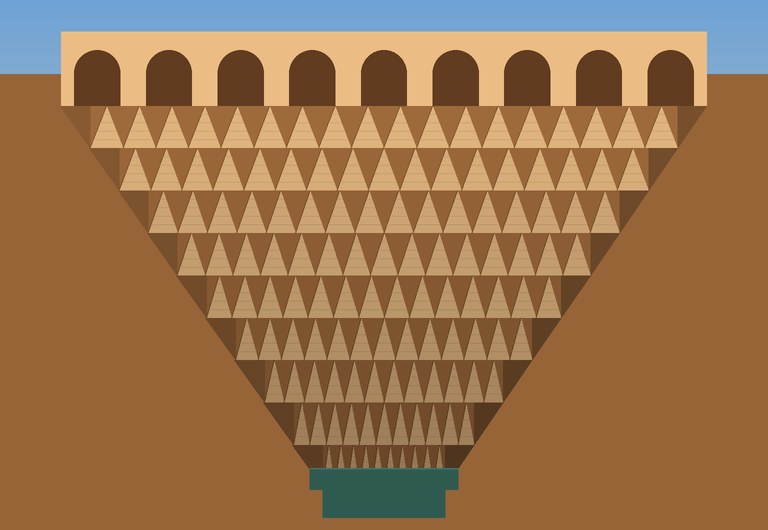
In the village of Abhaneri, in the Dausa district of Rajasthan, a square pit opens in the ground and drops about 30 metres. Its walls are covered with about 3,500 narrow steps arranged in a perfect zigzag pattern over 13 levels. This is Chand Baori, one of the deepest and most photographed stepwells in India.
Built for a dry land
Chand Baori was built around the 8th and 9th centuries. Local tradition links its name to Raja Chanda, a ruler of the area, although no inscription confirms who built it. In this dry region, rainwater collected in the well, and the steps let people reach it as the water level fell through the year.
The deep shaft also keeps the air cool. At the bottom it is about 5 to 6 °C cooler than at the surface, which made the well a pleasant place to rest on hot days.
A temple next door
Beside the stepwell stands the Harshat Mata Temple, an older temple dedicated to the goddess of joy. Carved stones from it can be seen around the site. Chand Baori has also appeared in several films, thanks to its striking geometry.
Visiting tips
- Abhaneri is often visited on the road between Jaipur and Agra.
- Visitors usually view the well from the galleries around the top. The steps themselves are not open for walking.
- Morning light shows the pattern of the steps most clearly.
Key facts
| Location | Abhaneri, Dausa, Rajasthan |
| Built | Around the 8th–9th century |
| Depth | About 30 m |
| Levels | 13 |
| Steps | About 3,500 |